Stop Surviving Days Full of Disruption and Start Thriving with Your Child
Help children develop behaviors that are safe and kind while you reclaim your peace of mind. Together we'll transform daily behavior battles into calm, collaborative routines.
Does this sound familiar?
- “I feel helpless and don’t know how to calm them down or keep everyone safe.” (You can find strategies to help with meltdowns here.)
- “Every morning is a battle to get my daughter out the door."
- “All the advice I find is about forcing my child to fit in, not about understanding their world.”
- “School calls me daily about my child’s behavior. I need solutions that work at home and at school.”
Whether you're a parent, teacher, or therapist, you'll find practical behavior treatment tools and compassionate neuroscience-backed strategies.
There are brain informed, connection based strategies to replace chaos with calm, conflict with collaboration, power struggles with partnership, and frustration with flexibility.
Author: Devina King, Occupational Therapist and Certified Autism and ADHD Specialist Last updated: 9/7/2026
Table of contents
- Your child isn't bad. Behavior is a symptom, fix the cause
- Develop the tools and keys to unlock your child’s potential
- Brain based behavior support for real life
- Learn strategies for common (and not-so-common) struggles
- From neurotypical toddler to neurodivergent teen and everything in between
- I lived it. I got it wrong. I learned it. I got it right
- FAQ
Your child isn't bad. Behavior is a symptom, fix the Cause
Our children are doing the best they can with the skills they have. And so are we.
Regulation, connection, and capacity come first.
Beneath every behavior lies a child’s unmet need and a gap in skills to meet that need in a way adults find acceptable. You can find common unmet needs, underdeveloped skills, and behavior treatment approaches for common behavioral challenges here.
Develop the tools and keys to unlock your child’s potential
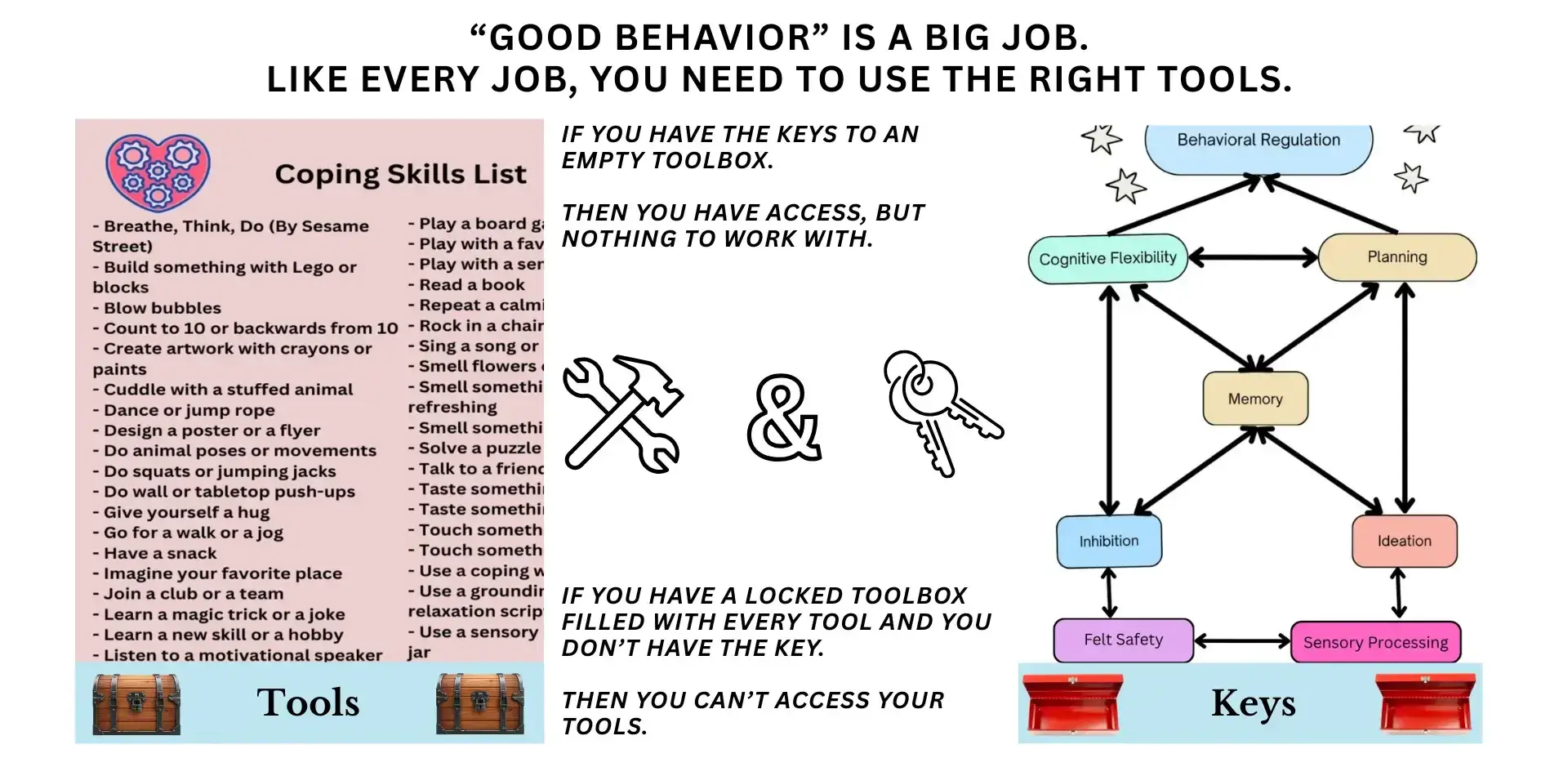
Imagine a toolbox filled with every tool you could dream of but the toolbox is locked tight. Those tools sit unused, no matter how essential they are. Now imagine you have the keys to that toolbox… but inside, it’s empty. You have access, but nothing to work with.
Tools
In behavioral regulation, tools are the concrete strategies you explicitly teach children:
- Deep breaths (You can find my favorite way to teach emotional regulation to kids as young as 1 year old here)
- Taking a break when frustrated
- Asking for help
Keys
In behavioral regulation keys represent the neurological and emotional capacity children need to use those tools:
- Brain networks that regulate stress and sensory input
- Interoception skills that let a child notice rising frustration
- Impulse-control circuits that pause a knee-jerk reaction (You can find some play based ways to build impulse control here).
- Resilience wiring that helps them bounce back from upset
What makes this behavior treatment different? Real change happens when you address both
Most behavior management strategies or behavior therapies stop at lecturing kids about the tools they should be using, or punish children for "choosing not to" use the tools, and ignore that the child doesn't have the keys!
When you combine tools + keys, you:
- Explicitly teach children the “how” (tools)
- Build the “can” and “will” (keys) through trauma-informed co-regulation and brain-based exercises
That synergy unlocks the full toolbox giving your child and you both the skills to handle challenges and the thriving neurological foundation to apply them with confidence.
Brain-based behavior support for real life
This approach blends the art and science of behavior support and skills building. It’s not just what research says; it’s how to make it usable in homes, in schools, and in clinical care.
I don’t just tell you what to do; I teach you how to apply evidence-based strategies and neuroscience-driven techniques to the real children in front of you.
Learn strategies for common (and not-so-common) struggles
- Prevent and respond to meltdowns, explosive behaviors, panic attacks, and tantrums with empathy and respect
- Reduce power struggles and convert daily chaos into mindful connections that strengthen emotional security
- Teach replacement behaviors through responsive modeling, effective communication, and mutual respect
- Build foundational brain skills including emotional regulation, felt safety, cognitive flexibility, interoception, impulse control, and resilience for lasting behavioral regulation
From neurotypical toddler to neurodivergent teen and everything in-between
You will find support for babies to teens including if your struggles include autism parenting, ADHD parenting, Pathological Demand Avoidance, Sensory Processing Disorder, Oppositional Defiance Disorder, Bipolar Disorder, Disruptive Mood Dysregulation Disorder (DMDD), child behavioral disorders, and neurotypical children with trauma, anxiety, or inflexibility. My resources and parent coaching services offer child behavior disorder help and parenting guidance rooted in effective behavior therapy and comprehensive pediatric mental health concepts.
I lived It. I got it wrong. I learned it. I got it right
I don’t just regurgitate research (although I am a research nerd!) and I never blame the child or their caregivers. In my three roles (as a parent, pediatric OT, and autistic adult), I moved from surface-level, compliance based, behavior fixes to a deep brain based, co-regulation, skills building, and collaboration approach.
This unique blend of lived and professional expertise shapes every strategy I share.
As a parent
My child’s behavioral disorder once put her on a path to be dead or in jail; learning to meet her neurological needs turned everything around.
As a clinician (pediatric occupational therapist)
I replaced compliance chasing with curiosity and capacity building, transforming how therapy actually works.
As an autistic adult
I have had to learn first-hand how to work with the brain I was born in instead of against it.
FAQ
What does it mean that behavior is a symptom?
Behavior reflects unmet needs, underdeveloped skills, or a dysregulated nervous system. When you address the cause, the behavior changes.
How do I know if my child’s behavior is a skill gap or defiance?
If a child cannot do it consistently, even with support, it is a skill gap. Most challenging behaviors fall into this category.
What are tools and keys, and why do children need both?
The Tools and Keys framework was created by Devina King to explain how behavioral regulation develops. Tools are the strategies we teach. Keys are the neurological capacities that make those strategies usable. Children need both to succeed.
Why do traditional behavior plans fail my child?
Because they assume the child has the capacity to use the tools. Many children do not yet have the neurological readiness.
What is co-regulation?
Co-regulation is when an adult lends their calm, steady nervous system to help a child regulate. It is the bridge to self-regulation.
Will this approach work for neurodivergent children?
Yes. This framework is designed for autistic children, children with ADHD, PDA, sensory processing differences, trauma histories, anxiety, and more.
How long does it take to see progress?
Many families see fewer power struggles and shorter meltdowns within weeks. Deep neurological change takes longer but is lasting.
Can this help with school behavior challenges?
Yes. When children build capacity and feel safe, behavior improves across environments. These strategies can be shared with school teams.
What if I feel overwhelmed or like I am failing?
You are not failing. You are learning new skills just like your child. This work is about connection, not perfection.
About Devina King, B.A. Psy, MSOTR/L, ASDCS, ADHD-RSP
Devina is an autistic occupational therapist, parenting coach, author, and credentialed autism and ADHD specialist with over 17 years of experience working with children, specializing in behavioral regulation and neurodivergence. As both a clinician and a parent, she combines professional expertise with personal experience parenting neurodivergent children who previously struggled with behavioral disorders. This unique perspective allows her to bridge the gap between science and real-world application, offering compassionate, evidence-based behavior treatment strategies that empower children to thrive.
You can learn more about Devina's credentials, lived experience, and approach here.
Publications
Devina has written many books. Her book From Surviving to Thriving: The Art and Science of Guiding Children to Develop Behavioral Regulation available on Amazon here, provides actionable insights for parents, educators, and professionals looking to support children in building essential self-regulation skills. Devina is an AOTA approved professional development provider. Reviewers praise her works for her comprehensive, refreshing and practical, compassionate approach that takes complex psychological concepts and evidence based approach and breaks it down into concepts anyone can understand and apply. Devina has been included in publications such as this article in Psychologist Brief available here and this article in Doctors Magazine available here. Stop by her store here to explore her latest resources, workshops, CEUs and parent coaching sessions designed to help children succeed in their behavioral development journey!